Why Teak Wood is the Best Material for Traditional Indoor Jhulas
If you've decided against modern stainless steel and want a traditional wooden swing, you will face choices like Sheesham, Rosewood, Mango wood, and Teak.
At Vrundavan Steel Industries, for our premium wooden line, we rigidly stick to CP (Central Province) Teak Wood. Here is why.
1. Natural Oils and Rubber Content
Teak wood possesses naturally high levels of oil and rubber. These internal compounds act as a permanent, built-in water repellent. Unlike Mango or Sheesham wood, which can absorb atmospheric moisture and swell during the Indian monsoons, teak remains dimensionally stable.
2. Unbeatable Termite Resistance
The same natural oils mentioned above are highly toxic/repellent to termites and wood-boring insects. This is why antique teak swings survive for literal centuries in Indian homes while cheaper woods turn to dust within a decade.
3. Exceptional Load-Bearing Strength
A swinging motion exerts dynamic stress on wood joints (unlike a stationary bed or table). Teak’s dense, tight grain structure ensures that screws, bolts, and metal anchor joints bite hard and never loosen under constant motion.
4. The Aesthetics
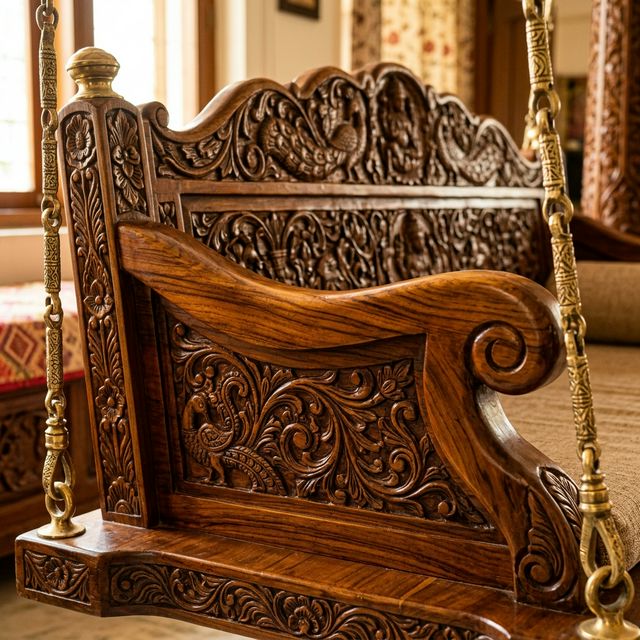
Teak's beautiful golden-brown appearance simply cannot be replicated. It holds heavy carvings intricately without splintering, making it the perfect canvas for Rajasthani or Gujarati royal jhula designs.
When buying a wooden jhula, ask the manufacturer exactly what wood they use. At our Gandhinagar factory, we guarantee 100% premium treated teak for all non-steel traditional swings.